What ENplus A1 actually means

Chris, CEO (fictional)
“ENplus A1” is printed on our bags in large letters, and rightly so. But I am regularly asked by customers, including some who have burned pellets for years, what it actually promises. Here is a straightforward explanation, with the real numbers.
A scheme, not a single test
ENplus is a certification scheme for wood pellets. It does not just test a sample once. A producer is certified for its whole supply chain: the raw material, production, storage, delivery and record keeping. Independent auditors check the producer, and the pellets must keep meeting quality limits batch after batch.
Our certification covers ENplus A1 and A2 (certificate reference UK-FICT-0417). The grades are built on a European standard that defines what a pellet is made of and how it should perform.
The grades side by side
| Parameter | A1 | A2 | B |
|---|---|---|---|
| Ash content | ≤ 0.7% | ≤ 1.2% | ≤ 2.0% |
| Mechanical durability | ≥ 98.0% | ≥ 97.5% | ≥ 97.5% |
| Net calorific value (NCV) | ≥ 16.5 MJ/kg | ≥ 16.5 MJ/kg | ≥ 16.5 MJ/kg |
| Moisture | ≤ 10% | ≤ 10% | ≤ 10% |
| Fines | ≤ 1% | also limited | also limited |
These are the headline figures. The standard also sets limits for things like chlorine, sulphur, nitrogen and heavy metals, and for the diameter and length of the pellet. Wood used for A1 must be stem wood or clean residue from untreated timber, not demolition or treated material.
Ash: the leftovers
Ash is what remains when the combustible part has gone. A1 allows no more than 0.7% of the pellet’s dry weight as ash, so a 15 kg bag leaves roughly 100 g or so behind. That is about a third of what grade B permits.
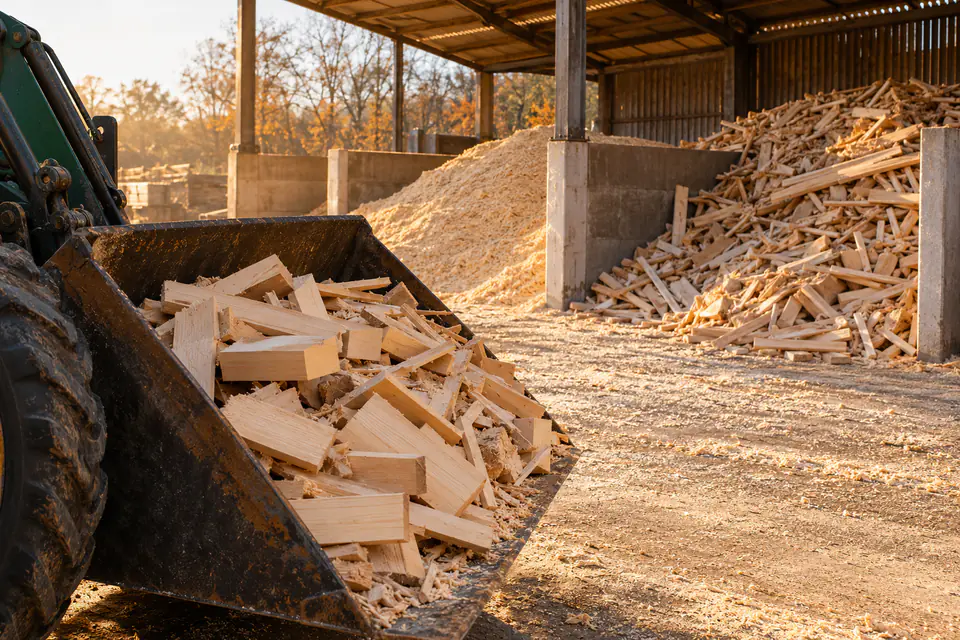
Less ash means fewer ash-pan trips and less chance of clinker, the hard glassy lump that forms when minerals melt in the burn pot. Bark and soil raise ash, which is why the cleanest raw material, such as kiln-dried joinery shavings and sawmill offcuts, goes into A1.
Mechanical durability: will it survive the journey?
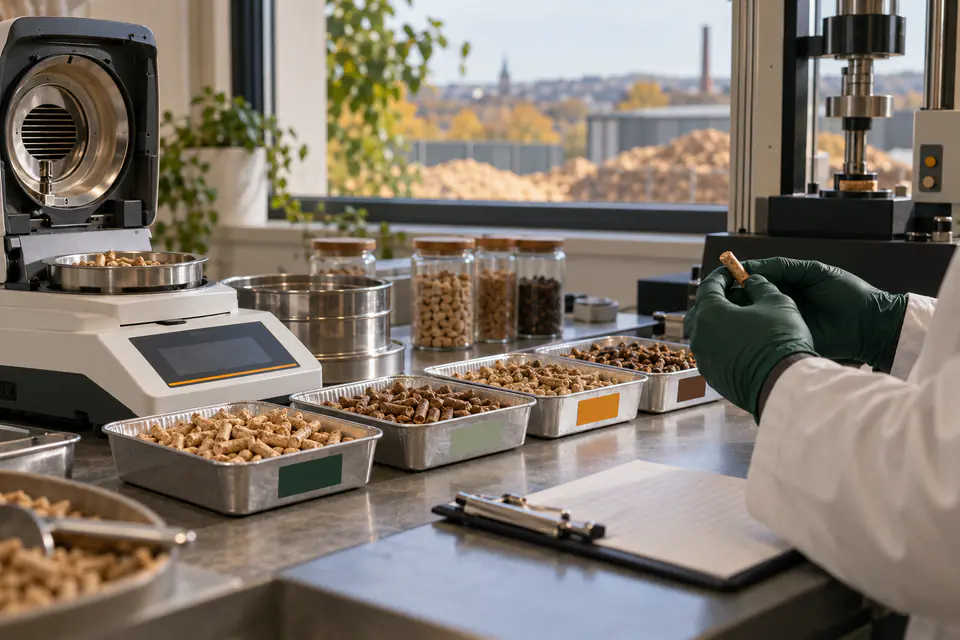
A pellet is dropped, tipped and conveyed several times before it reaches your hopper. Durability is measured in a tumbler: a sample is rotated, the dust is sieved off, and what remains is weighed. A1 must retain at least 98.0%, so under 2% breaks into powder. The A2 and B limit is 97.5%.
In our lab, Jo runs this tumbler test on every batch.
Net calorific value: how much heat you get
NCV, measured in megajoules per kilogram, is the energy you can use from a kilogram of pellets as delivered. All grades must reach at least 16.5 MJ/kg, which works out at around 4.6 kWh per kg. Roughly speaking, a tonne of A1 holds a bit over 4,500 kWh of useful energy, before appliance efficiency.
Notice that A1, A2 and B share the same minimum heating value. A cheaper grade isn’t a weaker fuel, just a dirtier one.
Moisture: the one that drifts
All grades must come in at 10% moisture or less. Water takes energy to evaporate, reduces the heating value, and makes a pellet swell and crumble. Moisture also tells you a lot about what’s gone on upstream. If the dryer isn’t coping or the wood arrives wet, it shows up here first, which is why we monitor it continuously, as a trend, not just as a pass or fail.
Fines: the dust
Fines are particles under 3.15 mm at the point of loading or packing. For A1 the limit is 1%. Too much dust clogs augers, burns unevenly and fills the bottom of the bag with a mess you didn’t pay for.
What A1 does not mean
A1 is a quality standard, not a promise of the best flame colour or the cheapest running costs. Your stove must suit the pellet’s size and grade. Most domestic stoves and boilers are designed and warranted for A1, and many accept A2 as well. Check your manual.
How we make sure
Our process relies on three layers of checking:
- Every batch is sampled and tested in the on-site lab for moisture, ash, durability, fines and an NCV estimate.
- Each batch is held in the warehouse until it has been released.
- An external UKAS-accredited lab confirms results monthly.
We are also audited as part of our ISO 9001 and ISO 14001 management systems, so that the records behind a result are as dependable as the result itself.
One last thing
The scheme’s value is trust. When you see a number on the bag, someone should be able to show you where it came from. If you ever want to know what is behind your delivery, ask. We don’t keep it in a hollow oak.