Our landfill diversion numbers

Chris, CEO (fictional)
It is easy to say a business is green. It is harder to show your working. This post sets out the numbers behind our claim that Gundi turns waste wood into heat, including the assumptions, because a figure without its assumptions is just a slogan.
All figures are approximate and rounded, and they are our own estimates rather than a verified carbon audit.
How much wood did we divert?
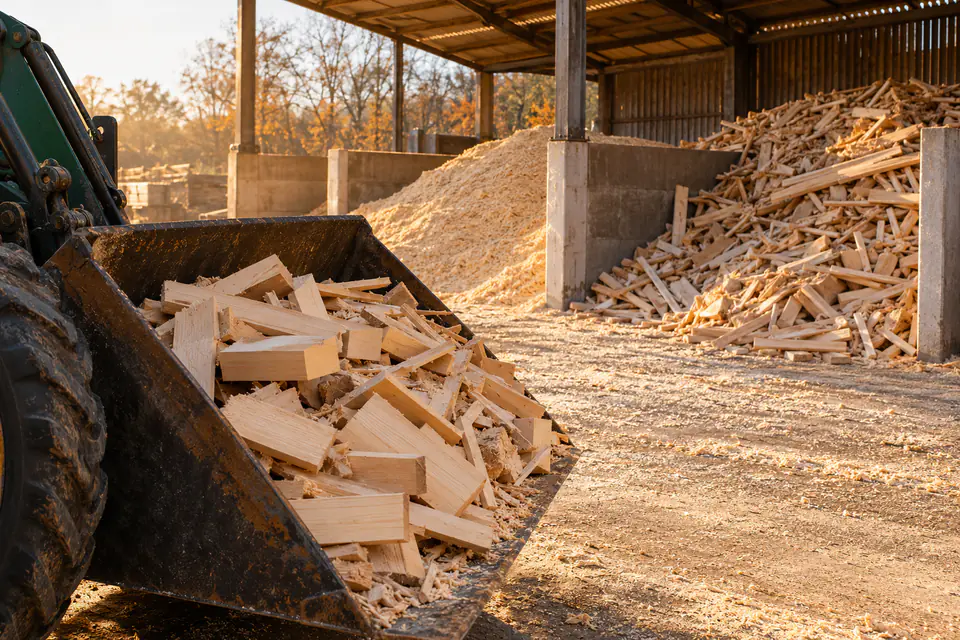
In 2025 we took in roughly 19,000 tonnes of clean wood that would otherwise have been landfilled, burned without heat recovery, or left to rot in a yard. It came from:
- sawmills and joinery shops (sawdust, shavings and offcuts)
- furniture makers (oak and beech offcuts)
- orchards and tree surgeons (prunings and arboricultural chip)
- clean pallet recycling (the grade B stream)
- a small January collection of Christmas trees with a local charity
The tonnage is measured at our weighbridge, as received. That matters, because green sawdust arrives wet. After drying and pressing, 19,000 tonnes of incoming wood becomes somewhere around 14,000 to 15,000 tonnes of finished product. The difference is mostly water driven off in the dryer, plus a small amount of screened-out material.
Not all of that product is heating fuel. Some goes into BBQ smoking pellets, animal bedding, cat litter and briquettes. The great majority, though, is fuel pellets.
A word about what “diverted” means
We count wood only if it would plausibly have had a worse destination. Our rules are:
- It must be clean, untreated wood within our environmental permit, which covers non-hazardous grade A wood.
- We don’t count virgin wood bought specially for pelletising, and we are trying to keep it that way.
- If wood had a buyer already, for example for panel board, we don’t claim it as diverted.
That last rule makes our figure conservative, though not perfect. Reasonable people could draw the line differently.
What do pellets displace?
Burning pellets only reduces carbon if it replaces something worse. For many of our customers, that something is heating oil, which is common in rural Nottinghamshire and Derbyshire homes off the gas grid.
As a rough guide:
| Fuel | Lifecycle emissions (kg CO2e per kWh of fuel) |
|---|---|
| Heating oil | about 0.25 to 0.27 |
| Wood pellets (lifecycle, including processing and transport) | about 0.01 to 0.05 |
The pellet range is wide because it depends on the feedstock, how the wood is dried and how far it travels. Our short supply chain and residue-based feedstock help us sit towards the lower end, but we are being cautious.
A rough sum
Take 14,500 tonnes of product a year. If, say, 13,500 tonnes of that is heating pellets with a heating value of around 4,600 kWh per tonne, that’s about 62 GWh of fuel energy.
- If all of it replaced heating oil at 0.26 kg CO2e per kWh and the pellets emit 0.03 kg, the saving would be about 0.23 kg per kWh, or about 14,000 tonnes of CO2e. That is a ceiling, not an estimate.
- Of course not all of it does. Many customers switch from gas, electricity, LPG or older solid fuel, and some boilers replace one biomass fuel with another. If we assume about a third of our heat genuinely displaces oil, the figure is nearer 4,500 to 5,000 tonnes of CO2e a year.
For a domestic comparison, a typical oil-heated home using 15,000 kWh a year emits roughly 3.9 tonnes of CO2e from the oil. The same heat from pellets would be under one tonne, perhaps nearer a few hundred kilograms.
What these numbers leave out
- Biogenic carbon. Wood releases carbon it absorbed while growing. We treat residues as near-neutral, but that is an accounting convention, not a law of nature.
- Landfill methane. Wood in landfill can generate methane as it decays, so diverting it could add to the benefit. We haven’t tried to quantify that.
- Appliance efficiency. Older boilers waste heat whatever the fuel.
- Particulates. Biomass combustion produces local air pollution, which is why good appliances and good fuel both matter.
What we are doing next
We want to publish a properly verified footprint instead of a back-of-envelope one. Raj is working with our consultants on data collection, and we’re tracking diesel use across our own fleet, including the blower tankers, as part of the exercise. Our ISO 14001 system gives us a framework, and we will share the findings when we have them.
We think waste wood is better in a stove than a skip. The numbers are an honest attempt to say by how much. Robin Hood redistributed wealth. We redistribute offcuts.